Category Archives: News

Chris welcomes Women and Equalities Committee Report

Today (25th April 2017) the House of Commons Select Committee published their report and findings into their enquiry into Disability and the Built Environment including housing and shared space schemes in the public realm. Chris welcomed the report’s recommendations saying:

“I’m grateful that the Committee has recognised the importance of this issue and consulted so widely with stakeholders and disabled people as well as disability groups. The impact on people’s lives when public spaces are not accessible is devastating. Inclusive design must be the golden thread that runs through all new buildings and works in the public realm.

 I’m also delighted that the committee agree with my recommendation that a moratorium on shared space schemes is necessary. Local authorities require clarity in this space and the exclusion of people from their communities and potential waste of public money must end.”

Key recommendations include:

  • Strategic leadership The Government has a range of levers that can be used to achieve more accessible built environments, but is not using them well enough. Greater co-ordination and leadership is needed to make this framework effective, and to make it clear that inclusive design is a statutory requirement, not just a ‘nice to do’.
  • Designing for equality The Government should make it easier for local planning authorities to follow this lead through revision and clarification of national planning policy and guidance. Local plans should not be found sound without evidence that they address access for disabled people in terms of housing, public spaces and the wider built environment; to support this, the Equality and Human Rights Commission should investigate the Planning Inspectorate’s compliance with the Equality Act. Planning consent should only be given where there is evidence that a proposal makes sufficient provision for accessibility.
  • Housing More ambition is needed in the standards the Government sets for the homes that the country desperately needs. Housing standards need to be future-proofed and to produce meaningful choice in housing, not just to respond to immediate local need. The Government should raise the mandatory minimum to Category 2, the equivalent of the former Lifetime Homes standard, and apply it to all new homes – including the conversion of buildings such as warehouses or former mills into homes.
  • Public buildings and places Much more can be done to make the public realm and public buildings more accessible: through building accessible workplaces, and incentivising employers to improve existing ones; by updating the regulations for new buildings and amending the Licensing Act 2003. Greater provision of Changing Places toilets should be a specific priority: such facilities should be required in all large building developments that are open to the public.
  • Shared Spaces Shared spaces schemes are a source of concern to many disabled people across the country, particularly features such as the removal of controlled crossings and kerbs and inconsistency in the design of schemes from place to place. The report recommends that the Government halt the use is such schemes pending the urgent replacement of the 2011 guidance on shared spaces, ensure that the new guidance is developed with the involvement of disabled people – and that it is followed in practice.

Read the full report here.

Chris called for a moratorium when he gave evidence to the committee, read more here
Chris responds to major industry review into shared space

The industry body tasked by the government with conducting a review into controversial shared space street design has today (9 January 2018) published its conclusions and recommendations. The CIHT review considered how shared space is being designed, implemented and installed across England and is based upon eleven detailed case studies. Most striking is that only one of the case studies was found to be ‘positive’ in respect of ‘inclusive environment’ and that was a scheme described as “very much on the limit of what might be called shared space” as it has several controlled crossings and clearly defined footway delineated by a traditional kerb. ‘Creating better streets: Inclusive and accessible places’ provides a series of recommendations to Government and industry that, should they be implemented, should ensure that in future authorities can achieve designs that meet the needs of all their users.

Chris said:

I have campaigned on the issue of shared space for several years and congratulate the CIHT on taking the issue of accessibility and inclusion in the public realm seriously. I am delighted that the recommendations include ensuring that local authorities understand their duties with regard to the Equality Act and also recognise that: greater awareness, better training, more research and improved guidance are all needed.

I’m also delighted that the report concludes – regarding crossings – that “there should be sufficient provision for all users to cross the carriageway safely and in comfort” and – regarding kerbs – that the separation between carriageway and footway “should be clearly delineated and detectable by all”.  It is essential that all our public spaces are safe, inclusive places for us all to enjoy.”

Chris Holmes

The recommendations include:
– the need for greater awareness to create streets that are inclusive and accessible;
– the development and use of a framework of objectives and outcomes for the basis of street design;
– the need to replace the use of shared space as a concept with different design approaches;
– the need for detailed research into the needs of all users and around specific design features;
– the review of existing guidance and the development of new guidance to assist local authorities in producing better street design;
– and, consideration of amending legislation in certain areas.

Find the full report here

Launch of Parliamentary group on Assistive Technology

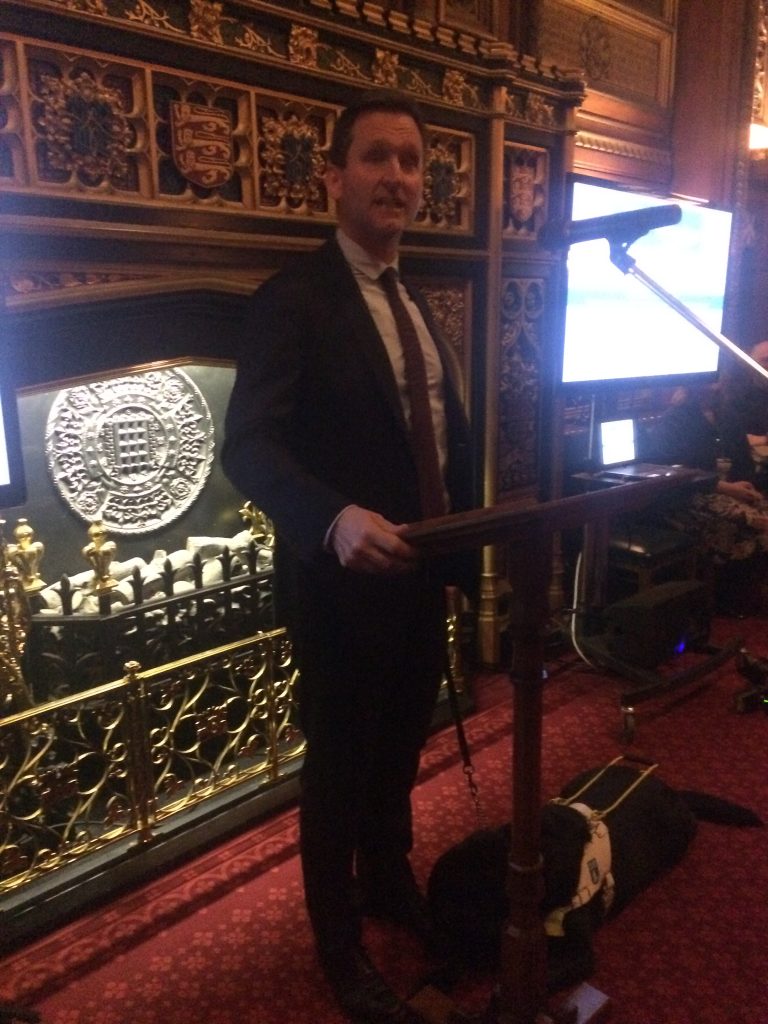
Chris in front of ornate fireplace with microphone and lectern.
Chris speaking at the launch event in Speakers House

Chris is delighted to be Co-Chair of a new All Party Parliamentary Group on assistive technology.

The group aims to disseminate knowledge, generate debate and facilitate engagement and a greater understanding of assistive technology amongst members of parliament. The group is supported by a number of organizations ranging from academic institutions to manufacturers of assistive technology and disability charities.

On the day of the launch a group of key stakeholders met to discuss aims and objectives. One key issue raised was the unacceptably high disability employment gap (40% of disabled people are unemployed compared to 5% of non-disabled population) and the role assistive technology can play in providing solutions. Questions were also raised over what was perceived as limited dialogue between the industry and government, and departments with government, it is hoped that this group will help address this communication and understanding gap and lead to far greater access to assistive technology for far more people.

The group had invited Hannah Rose to share her experiences of using assistive technology after she was paralyzed from the neck down at the age of fifteen. Thanks to various products including mobility aids, environmental controls (allowing her to turn off the lights and switch TV channel independently) and drag and dictate software (allowing her to use a computer) she enjoys a significant degree of autonomy and loves her job at Cheshire Police HQ – she jokes about how difficult it was to convince officers that she had found a job when she was trying to sign off incapacity benefits.

Access to employment is important but assistive technology is not only about jobs. It is about enabling people in a far broader sense, to live independent and fulfilling lives. It is about finding and making available the tools that allow people to overcome barriers and Chris relishes the challenge of  working with the group to make sure that happens.

Chris making speech at launch event in Speaker's House with guide dog Lottie

Launch of Parliamentary Group on Assistive Technology

Chris is delighted to be elected Co Chair of a new All-Party Parliamentary Group on Assistive Technology. The group aims to disseminate knowledge and generate debate. As well as facilitating engagement and a greater understanding of assistive technology amongst members of parliament.

Aims of the group

The group is supported by a number of organizations ranging from academic institutions to manufacturers of assistive technology and disability charities. On the day of the launch a group of key stakeholders met to discuss aims and objectives. One key issue raised was the unacceptably high disability employment gap (40% of disabled people are unemployed compared to 5% of non-disabled population). Assistive technology can play an important role in removing barriers to employment for people with disabilities.

Questions were also raised over what was perceived as limited dialogue between the industry and government, and departments with government. It is hoped that this group will help address this communication and understanding gap and lead to far greater access to assistive technology for far more people.

Why it is so important

The group had invited Hannah Rose to share her experiences of using assistive technology after she was paralyzed from the neck down at the age of fifteen. Hannah uses various products including mobility aids, environmental controls (allowing her to turn off the lights and switch TV channel independently) and drag and dictate software (allowing her to use a computer). Thanks to this assistive technology, Hannah enjoys a significant degree of autonomy and loves her job at Cheshire Police HQ. She jokes about how difficult it was to convince officers that she had found a job when she was trying to sign off incapacity benefits.

Access to employment is important but assistive technology is not only about jobs. It is about enabling people in a far broader sense, to live independent and fulfilling lives. It is about finding and making available the tools that allow people to overcome barriers and Chris relishes the challenge of  working with the group to make sure that happens.

Policy Connect provide the secretariat for the All-Party Parliamentary Group on Assistive Technology or APPGAT

Chris on new Vision 2020 podcast

VISION 2020 UK, the umbrella organisation which leads collaboration in eye health and sight loss, has launched a podcast. This new platform will look at the major topics of interest within the eye health and sight loss sector, with expert analysis, opinion and debate. The podcast is an educational forum for professionals, service users and carers as well as those with no knowledge of the topics.

Hosted by John Welsman, Guide Dogs Policy Business Partner, the podcasts will be released on a monthly basis and will focus on one topic or interview per episode, highlighting the work of the VISION 2020 UK Standing Committees, as well as discussions with leaders in the sector on topics such as rehabilitation, dementia, children and certification.

The first two podcasts are now available through the VISION 2020 UK website, on audioboom, and will soon be found on iTunes (search ‘VISION 2020 UK’). These episodes feature Mercy Jeyasingham, CEO, VISION 2020 UK and Chris! Chris gives listeners an understanding of his background, his achievements to date and his areas of concern and interest around eye health and sight loss. One of his major areas of concern is the issue of shared space.

John Welsman, commented, “Podcasts are a great way of discussing complex topics as well as being entertaining and informative. The ability of people to listen to the podcast on their commute, in their car or at home is a great way of communicating these issues. I look forward to working with VISION 2020 UK to create an engaging and professional podcast”.

Listen to Chris’s interview

Lord (Chris) Holmes, Lord Shinkwin holding accessible guide to pubs and starting in front of bar in a pub. Guide dog Lottie on floor.

“PUBS ARE FOR EVERYONE; WHY BEING ACCESSIBLE IS IMPORTANT.” GUIDANCE LAUNCHED.

The British Beer and Pub Association (BBPA) has published updated guidance for pubs to help licensees make their venue as welcoming as possible to those with access needs. Chris was at the launch and is delighted to endorse the guidance saying it:

“provides lots of useful information for licensees to help those with access needs enjoy the Great British pub.”

The foreword to the guidance is written by Baroness Tanni Grey Thompson DBE, who points out that:

“accessibility is not simply about physical access to the pub, but rather it is about creating the best experience for all who visit”.

The guidance gives six key features for an accessible pub:

1. Access ramp at door

2. Hearing loops on bar

3. Large print menu

4. Accessible toilet with disability sign on door

5. Staff trained to meet needs of disabled customers

6. Layout – easy to navigate and clear of obstacles.

Let’s hope the guidance is circulated widely and embraced by all pubs. Read the guidance in full.

DELIGHTED REACTION TO NEWLY ESTABLISHED “PAULLEY PRINCIPLE” ON ACCESSIBLE TRANSPORT

The Supreme Court today ruled on a long running dispute between FirstGroup Plc and Doug Paulley.

In 2012, Mr Paulley, a wheelchair user, had been unable to board a bus when another passenger with a pushchair refused to move allow him to use the space. 

Mr Paulley  had argued operator FirstGroup’s “requesting, not requiring” policy was discriminatory. 

The court ruled that this policy of requiring a driver to simply request a non-wheelchair user to vacate the space without taking any further steps was unjustified.

Chris welcomes the “important milestone” but noted that as the judgement was with limits it may be necessary to look again at issues with existing legislation.  

Further legislation may offer the clarity and emphasis that is so urgently required to make sure disabled people feel confident about exercising an equal right to access public transport.

Football fans at match including a fan who is also a wheelchair user.

Chris welcomes commons report into accessible stadia

Top of the league clubs: Derby County, Wrexham, Tranmere Rovers, Egham Town; all have been named as examples of excellence in making their clubs truly welcoming of disabled supporters. You will note that none of these clubs are in the Premier League.

In September 2015 the Premier League promised to make all clubs accessible to disabled people. The House of Commons Select Committee on Culture Media and Sport report, published today (January 16 2017) states that it is

“very clear” that sports clubs, notably many of those with very considerable income and resources, have not done anywhere near enough for sports fans with disabilities in recent years, despite the increase in income many of those clubs have enjoyed.”

The House of Commons Select Committee on Culture Media and Sport report, 2017

Given the examples above I would say it is clearly a question of will rather than resources and Greg Clarke of the Football Association agrees, telling the committee:

“that for the Premier League the problem was not money”.

Greg Clarke, Football Association

Football is our national sport, beloved by so many of us, and it needs to rediscover its moral compass. If not on its own then with some help. Both the commons committee and the Minister for Sport have said they would support legal action against clubs that miss the August deadline and Bill Bush, executive director at the Premier League spoke of fines of up to £25,000.

I would urge both the Premier League and the Equality and Human Rights Commission to use all means at their disposal to ensure that disabled supporters are no longer treated as second class citizens when they want to support their football team.

Chris Holmes

Chris’s letter to the Times: Football’s Failure

Watch Channel 4’s report: Are football stadia no go for disabled?

BBC Sport: Disabled access: Premier League clubs may face sanctions over lack of improvement

Why did the blind man cross the road?

Shared Space Blog from Chris:

I have been campaigning for some time against a street design approach known as “shared space” which has, de facto, led to the creation of unsafe environments which discriminate against blind people and negatively impact the vast majority of users.

The Department for Transport defines shared space as:

A street or place designed to improve pedestrian movement and comfort by reducing the dominance of motor vehicles and enabling all users to share the space rather than follow the clearly defined rules implied by more conventional designs.”

Department for Transport, LTN 1/11

The key part here is a desire for “all users to share the space” so “traffic signals are often removed, with indications of priority at minor junctions omitted… conventional kerbs are omitted and pedestrians share an undifferentiated surface with vehicles.”

On Wednesday I gave evidence to the Women and Equalities Committee whose inquiry into disability and the built environment has asked “to what extent do shared space schemes in roads and highways cause barriers for disabled people and how can these be resolved?”

Throughout the course of my campaign, increasing numbers of professionals have responded by asserting that shared space is no longer a useful term. Indeed, the man who claims responsibility for introducing the term in 2003, Ben Hamilton-Baillie, who also gave evidence, claimed that “the term has stuck in ways it was never meant to.” Discomfort over the term has even extended to one local authority currently introducing a scheme in Bodmin, where the council website now statestechnically we are not delivering a true shared space scheme.”

Whilst, like any campaigner, I am pleased to have arrived at an area of consensus, and I can certainly agree that “shared space” is a complicated, confusing and contested term I would also have to insist that as long as the government continues to use the term in official guidance the confusion will continue.

A further area of agreement that all sides have arrived at is the need for much better data. It seems very hard to find evidence that satisfactorily answers questions about the accessibility of these schemes as it is so rarely included as an objective, or indeed consideration, of a design plan.

Clearly, arguing about a definition of shared space is far less useful than taking a closer look at design components and what impact those features have. I am in no way opposed to: innovation and change, a more attractive public realm, or town centre regeneration but it is absolutely essential to look at how this is achieved.

If inclusive design is not the bedrock from the outset, schemes will inevitably fail, exclude, cause confusion, chaos and significant potential cost to councils facing legal challenges and further works. Pedestrian crossings are a key area. Of the 14 local authorities enacting U-Turns on their so called shared space schemes, 11 have reintroduced crossings.

The DfT have suggested that a review of shared space currently underway by the Chartered Institute of Highway Transportation will reconcile many of these concerns although CIHT stated yesterday at the evidence session that although their review will make recommendations it will NOT be sufficient to update guidance and that that would require further input from the government.

Real change will only be achieved when local authorities put inclusive design at the heart of any work in the public realm and this means asking at the outset “how does a blind person cross the road”?

Filming with BBC Breakfast at Sloane Square shared space. Chris and Lottie speaking to journalist.

Parliamentary Inquiry to Look at Shared Space

Chris welcomes the Women and Equalities Committee’s decision to conduct an inquiry into disability and the built environment.

The inquiry will ask whether more could be done to increase the accessibility and inclusivity of both new and existing properties and spaces. In particular the inquiry will ask whether shared space schemes in roads and highways cause barriers for disabled people and how can these be resolved. 

Chris did some filming with BBC Breakfast in Sloane Square and they also sent cameras to Poynton to draw attention to the inquiry. You can see Chris’s evidence here and follow the inquiry through the committee’s website.

The terms of reference for the inquiry include:

Design and management of the public realm

  • Are the needs of all groups given adequate consideration in the design of streets, highways, parks and publicly accessible open spaces and in the provision of services such as public toilets?
  • To what extent do shared space schemes in roads and highways cause barriers for disabled people and how can these be resolved?
  • What opportunities are there for delivering greater accessibility and inclusivity alongside more age-friendly towns and cities, including liaison with the NHS?

Media response:

The Times, “Shared spaces for drivers and pedestrians ‘are causing chaos’”, October 24th 2016.

Evening Standard, “Roads shared by pedestrians, cyclists and drivers ’cause chaos’, government report finds”, October 24th 2016.