Category Archives: News

Talking Buses come to Manchester

Chris, guide dog Lottie and representative from Manchester Metroshuffle Bus Service standing in front of a bus in Manchester
Chris and Lottie in Manchester for new talking bus service

Chris joined transport bosses in Manchester to formally launch new equipment on the city’s free Metroshuttle service. Chris was delighted to support the launch observing  that the improvements are a fantastic way of ensuring the city’s transport network is more accessible.

The Department for Transport’s Green Bus Fund and Transport for Greater Manchester funded the 20 Optare low carbon buses that operate on the Manchester Metroshuttle routes. Transport for Greater Manchester paid for them to be retrofitted with brand new passenger information screens, making travel easier for passengers with visual or hearing impairments.

The 19-inch high-resolution screens provide automatic audio and visual announcements for passengers on aspects of the journey such as the route plan and the next stop, as well as places of interest and nearby businesses. The technology was fitted by contractors McKenna Brothers working with the charity Guide Dogs UK.

Chris was given a guided trip on one of the buses to experience the new technology for himself and he was delighted to congratulate Transport for Greater Manchester for the initiative which will mean people living with visual or hearing impairments can feel more confident in travelling independently.

Chris has spoken in Parliament on the importance of talking buses during debates on the Bus Services Bill.

Disappointment as Premier League Fails to Keep Promise.

Chris speaking to a BBC journalist about accessible stadia. Cameraman filming. Standing on pavement outside the Palace of Westminster
BBC Interview about accessible stadia

More than a third of Premier League clubs, including two of the richest teams in the world, will not have adequate facilities for disabled fans by August 2017.

Accessible Stadia

Chelsea, Liverpool, Crystal Palace and Bournemouth are all set to miss an agreed deadline to bring their stadiums up to the minimum standards for disabled access, according to the disabled fans organisation Level Playing Field (LPF).

Last year, all Premier League clubs pledged to improve their stadium facilities for disabled supporters and increase the numbers of wheelchair user spaces by August 2017, as set out in the Accessible Stadia Guidance (ASG).

Broken Promises

However, in meetings with the Equality and Human Rights Commission, which took the league to task last year over inadequate accessibility provisions, the Premier League has now acknowledged that many will miss the deadline.

Commenting on the lack of progress, Chris Holmes, EHRC Disability Commissioner said:

“All clubs agreed to make the minimum recommended improvements for disabled fans over two years. We are now at half-time, and for many teams, the performance is simply unacceptable.”

Chris Holmes

The Commission has warned that clubs could now face legal action.

The Telegraph, Exclusive: Premier League clubs accused of betraying disabled fans with a third failing to meet wheelchair access promise.

BBC Sport, Premier League: Up to third of clubs to miss deadline for disability access

Chris Welcomes Premier League Pledge to Improve Access for Disabled Supporters

Chris welcomes the Premier League statement, which promises that all clubs will comply with the Accessible Stadia Guide by August 2017.

There has been a long campaign to improve stadium facilities for disabled supporters and increase the numbers of wheelchair spaces, for years substantially fewer at most clubs than the numbers recommended in official guidance.

On Monday, the government published a deeply critical report about disabled people’s experience in sports stadiums. This came after years of campaigning by various organisations and supporters groups and as Lord Faulkner’s Accessible Sport Grounds Bill is considered in Westminster.

Chris has taken part in the debates calling on the football community to 

“rediscover their moral compass.”

Chris Holmes

There was widespread praise in the House of Lords for the move by the Premier League but Chris urged the government to “monitor closely” the progress being made up to 2017.

BBC, Premier League clubs to make changes for disabled fans.

The Guardian, Premier League pledges to improve stadium facilities for disabled fans.

Telegraph, Premier League face the threat of losing sponsors over clubs’ inadequate provision for disabled fans.

Mirror, Paralympic swimmer Lord Holmes urges Premier League clubs to provide more seats for disabled fans.

Accidents by Design: The Holmes Report into Shared Space

On Friday 1st July I published detailed research into so called “shared space”.  This is the architectural conceit, the planning folly, which proposes that the removal of kerbs, road markings, controlled crossings such as zebras and pelicans and so on leads to a better experience for all users of our streets.  To be clear this means no road or pavement, no safe space, buses and blind people, toddlers and trucks sharing the same space.  Unsurprisingly, the research findings do not support a sunny view of shared space.

Sixty-three per cent of respondents reported a negative experience of shared space. Even more worryingly, thirty-five per cent said they actively avoided shared space, that’s over a third of people planned out of their local community, their local shops, their local support services.  This type of totalitarian planning would make even an old style Soviet feel some shame.  The research also indicated a significant under reporting of accidents in these shared spaces.

The findings are stark, the solution clear, an immediate moratorium on all shared space schemes until thorough impact assessments can be conducted.  This must be combined with a central record of accident data including “courtesy crossings”, which must be defined and monitored.  There is also a need for updated Department for Transport guidance to enable local authorities to fully understand their obligations, not least in relation to the Equality Act.  

Has so called “shared space” achieved an inclusive experience for all? No, it most certainly has not.  Has it opened up our high streets, increased safety and usability? Again, no it has not. Shared space is not a safe place nor a pleasant place, it has turned high streets into traffic free for alls, it has caused confusion, chaos and catastrophe.

In the words of survey respondents, shared space is:

 “Lethally dangerous” (Pedestrian)

“Absolute nightmare that I avoid if I can.” (Driver)

“Shared space is a false promise with poor delivery” (Cyclist) 

Shared-use streets a safety disaster says, ex-Paralympian, BBC News

Halt city ‘shared spaces’, says report by Lord Holmes, BBC News

Cars and pedestrians don’t mix well concludes study into shared space schemes, Independent

Chaos, Confusion and Catastrophe, Politics Home

Shared space schemes labelled dangerous in Lords report, Architects Journal

The Holmes Report into Shared Space, Cycling Embassy of Great Britain

Ex-Paralympian in call to end shared space crossings, Swindon Advertiser

Time to stop sharing?, Lord of the Blogs

Daily Politics asks if ‘shared space’ is safe….

End of the road for white lines on highway, The Times

Please tweet using #stopsharedspace

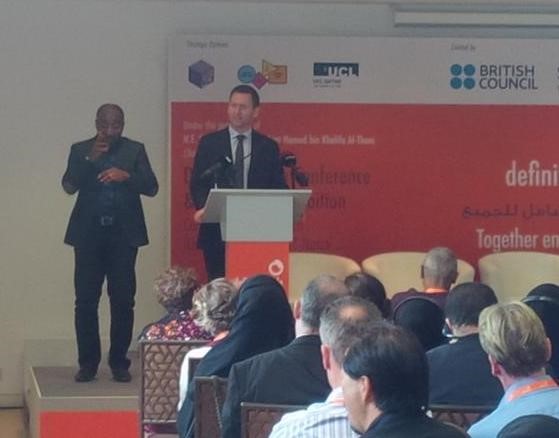
Definitely Able, Doha

Chris standing at podium on stage at Definitely Able Conference in Doha

Chris travelled to Doha to take part in the Definitely Able Conference held in the amazing surroundings of the Museum of Islamic Art.

Sasol and the British Council, in partnership with Qatar Museums, partnered to organise the conference and accompanying ILHAM art exhibition.

The two-day Definitely Able Conference addressed the theme of ‘together enabling inclusion’, which reflects the partners’ belief that through dialogue society can become more inclusive for the benefit of all.  

The conference brought together an audience of more than 200 stakeholders in the disabled community, the private and public sectors.

Sasol and the British Council work together to challenge perceptions about disability.

Launch of New ‘Passport’ Guide for Disabled Travellers

Ade Adepitan in wheelchair, Chris Holmes with guide dog Lottie, both holding passport guides in Heathrow hall.
EHRC launch ‘Passport’ guide to your rights for disabled travellers.

This summer the Equalities and Human Rights Commission have published a handy passport sized guide to your rights when you fly as a disabled traveller. Due to a legal loophole the rights we citizens enjoy on the ground in UK and EU countries are replaced by an outdated agreement known as the Montreal Convention when we board a plane. What this means for disabled travellers is that should anything go wrong in the air, or indeed airside when you have cleared check in, you will not be protected by the rights enshrined in domestic equality legislation. The passport guide has been produced to help travellers know what rights they do have and what measures they can take to make sure they have the smoothest journey possible. Read Chris’s blog on the subject.